
R910,00
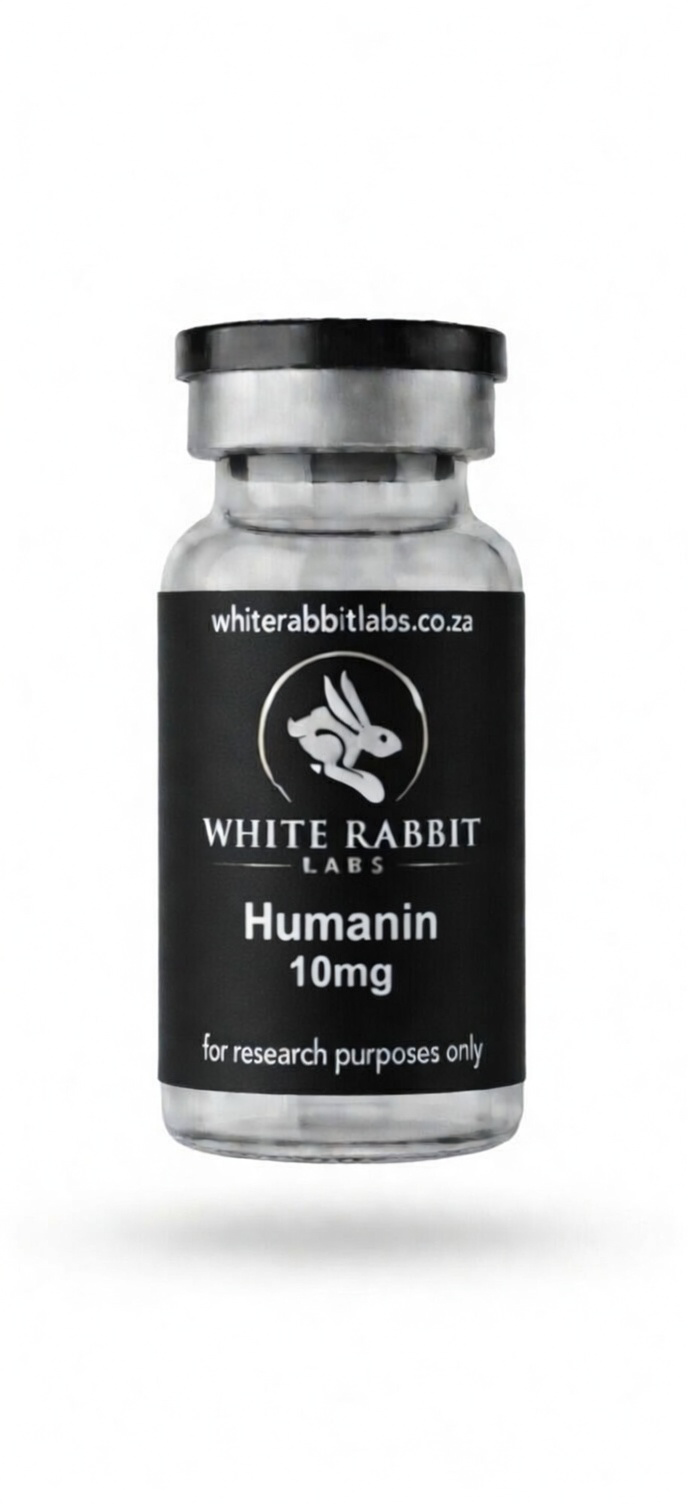
Neuroprotection, Oxidative Stress, Toxicity, Inflammation, Metabolic Health, Insulin Sensitivity, Cardiovascular Health.
R910,00
Out of stock
Humanin is a lab-made synthetic version of a naturally occurring 24-amino-acid mitochondrial-derived peptide (MDP) encoded in the mitochondrial 16S rRNA gene. Discovered in 2001 while screening for factors that protect neurons from Alzheimer’s-related toxicity, it acts as a stress-response signal from mitochondria to the rest of the cell. Humanin (and its potent analogs like HNG/S14G) is studied for cytoprotective, neuroprotective, and metabolic effects.
Think of Humanin as your mitochondria’s ’emergency SOS signal’ that protects cells under stress and promotes healthy aging.
How it works (super simple):
– Binds receptors (e.g., FPRL1, CNTFR/WSX-1/gp130) and directly inhibits pro-apoptotic proteins (Bax/Bid) at the mitochondrial membrane.
– Activates survival pathways (STAT3, ERK, AKT), reduces oxidative stress, and improves mitochondrial function/insulin sensitivity.
Main benefits (strongest from preclinical models and human correlations):
– Neuroprotection: shields neurons from amyloid-beta toxicity, oxidative stress, and inflammation; potential in Alzheimer’s, Parkinson’s, and stroke models.
– Metabolic health & insulin sensitivity: improves glucose metabolism, reduces body weight gain in obesity/PCOS models, and enhances exercise adaptations.
– Longevity & health span: correlates with longer lifespan in mice; analogs extend median lifespan and reduce inflammation in midlife treatment studies.
– Bonus signals: cardio protection, anti-inflammatory effects, and support for reproductive/ovarian health in aging models.
In short: It helps cells survive stress and age more gracefully by optimizing mitochondrial signaling – one of the most promising MDPs for anti-aging research.
Humanin shows an excellent short-term safety profile in preclinical and limited human correlation studies endogenous and generally well-tolerated.
In available data: No major toxicities; effects are context-dependent (beneficial in most stress models).
Mild/rare effects:
– Possible transient metabolic shifts (e.g., mild glucose changes – monitor in diabetics).
– Injection-site irritation (rare).
Bigger caveats:
– Unknown ultra-long-term human effects -no large therapeutic trials; some contexts may promote certain inflammatory or tumor-related pathways (theoretical).
– Sex-dependent responses noted in some models.
Bottom line: Appears very safe at research doses – far cleaner than many synthetic peptides – but human data is still emerging.
Reconstitution, dosage and cycling protocols for research purposes.
Method of Administration: Subcutaneous into fatty tissue.
Reconstitution: 2ml Bac water into single vial. See Reconstitution Guide
Dose: 2mg daily, therefore 20 units or 0.2ml. Use peptide calculator (link) for alternative dosage.
Course: 20 days.
Cycling: Repeat every 3 months for maintenance or as needed (e.g., during respiratory seasons or after illness).
Human data is mostly correlative (levels in aging/AD); strongest evidence is preclinical (mice, cells) with promising longevity/metabolic signals.
1. Coradduzza et al. (2023 PMC): Comprehensive review – Humanin improves glucose/insulin sensitivity in animal models; links to aging, metabolism, and cytoprotection.
2. The Peptide Catalog (Feb 2026): Dosing guide 100300 mcg research range; mechanisms (Bax/Bid inhibition, STAT3 activation); longevity protocols.
3. Swolverine (Jul 2025): Beginner guide – neuroprotective, metabolic, and anti-aging benefits; safe endogenous peptide.
4. ScienceDirect overview: Protective effects in neurons, leukocytes, gonadal cells; stress resistance and potential in neurodegeneration.
5. Peptide Calculator App (Dec 2025): Dosage/mechanism – insulin sensitivity, neuroprotection; 1001000 mcg ranges in research.
6. Yen et al. (2013 PMC): Emerging role in stress resistance; cytoprotective against oxidative stress, hypoxia, etc.
7. Aging-US (Jun 2020): Humanin regulates lifespan/healthspan in mice; midlife HNG treatment improves metabolic parameters and reduces inflammation.
8. Paragon Sports Medicine (2026): Energy & healthy aging mitochondrial optimization, cellular protection; research-only status.
9. Alzheimers Drug Discovery Foundation (updated references): Evidence summary – neuroprotective in AD models; insulin sensitivity and healthspan benefits; no human therapeutic trials yet.
10. ResearchGate / lifespan study (Dec 2025 update): Midlife HNG extends healthspan and lifespan in mice; first demonstration of MDP regulating longevity.
Takeaway: Strong preclinical longevity/neuroprotection data + human correlations; we need large clinical trials for therapeutic validation.
Collagen Production, Skin Rejuvenation, Antioxidant Protection, Anti-Inflammatory, Rapid Healing, Tissue Repair.
R1 400,00
Energy, Focus, Mood Boost, Mental Clarity, Reduced Fatigue, Addiction Recovery, Anti- Aging, Neuroprotection, Reduced Inflammation.
R1 650,00
Cartilage Protection, Joint Health, Osteoarthritis Progression, Connective Tissue Repair, Anti-Inflammatory & Anti-Aging effects
R550,00
Enhanced Deep Sleep, Cognitive Benefits, Mood Enhancement, Longevity
R590,00
Enhanced Energy, Exercise Performance, Metabolic Health, Glucose Control, Endurance, Physical Capacity, Anti-Aging, Fat-Loss, Inflammation.
R1 160,00
Rapid Healing (Ligaments, Joints, Cartilage), Gut Repair, Pain and Inflammation, Nerve and Brain Protection, Blood Vessel and Organ Protection.
R550,00